Model · How they make money
Costco isn’t a store. It’s a subscription.
Why the $1.50 hot dog is the cheapest ad in America, and what could break the machine behind it.
 Upstairs
Data as of October 26, 2026
7 min read
15 sources · 4 charts
$5.9bn
Paid just to walk in, fiscal 2026
- Floor1 · Model
- Video1:42
- Letter7 min · 15 sources
In this articleWhat you’ve heard
That’s what 84 million members paid Costco in its last fiscal year, before buying a single thing. Just for the right to walk in.
Then Costco gave a big part of it back: its Executive members earn 2% on most of what they buy.
And by Costco’s own estimate, its gas stations saved members almost as much again.
A store that returns more than half of what it charges at the door, in rewards alone. Here’s how the machine works, the number almost everyone gets wrong about it, and what could break it.
What you’ve heard
How much of Costco’s profit comes from the card? Three outlets, three answers.
- 64%
Membership fees accounted for roughly 64% of Costco’s profits.
TheStreet, February 2026 - ⅔
…equal to roughly two-thirds of its net income.
CNBC, July 2026 - All
Costco essentially reaps all of its profit from its membership fees.
Money, October 2019
MisleadingThey divide fees counted before tax by profit counted after tax. Like for like, fees equal about half of operating income (the profit from running the business, before tax), and that share is falling. See the facts
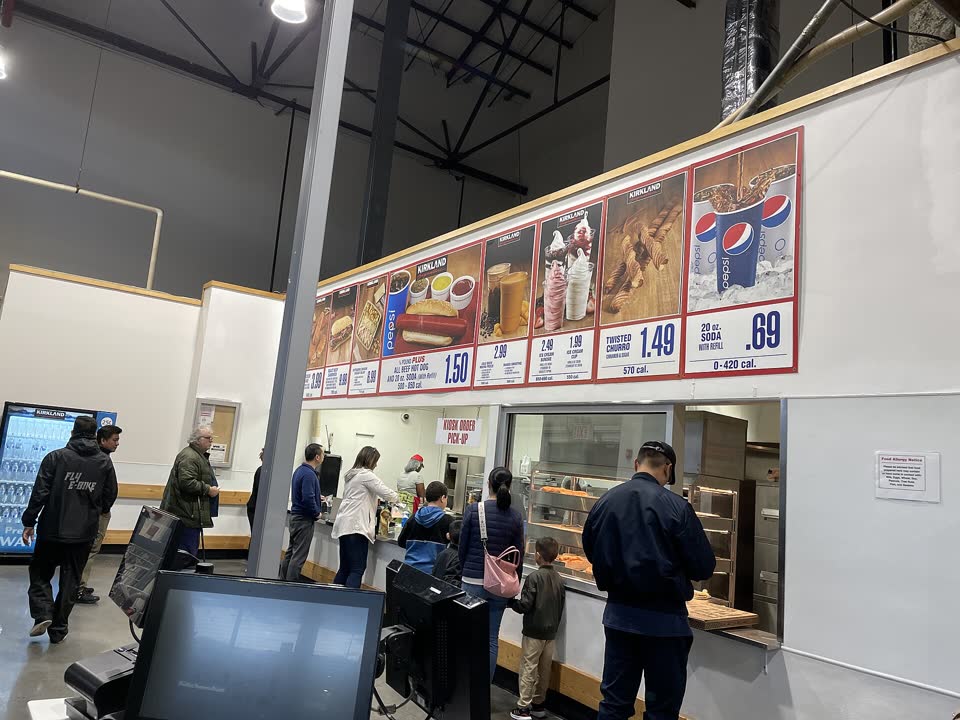

Does Costco lose money on the $1.50 hot dog?
We are losing our rear ends.
Craig Jelinek, then Costco’s chief executive, on the hot dog, as he told it in 2018 (Mental Floss, TODAY)
Never shownCostco has never published what the hot dog, or the food court, earns. What it does publish: 245 million combos sold in fiscal 2025, at the same $1.50 since 1985. See the facts
Downstairs, the noise.
Upstairs, the facts.
That’s the Upstairs rule: a claim stays downstairs until a filing or a second source backs it up. From here on, everything does.The deal: Costco barely profits on the shelves
That’s what Costco keeps of every sales dollar once it has paid for the goods. Walmart keeps 24 cents. Target, 28. Here’s why that number is so low, and why it never moves.
A cap on every product. Costco has long capped what it makes on each item. In 2007, co-founder Jim Sinegal put the limit at 14% on brands and 15% on Kirkland, Costco’s own label. His successor, Craig Jelinek, repeated the same numbers in 2016. It shows in the accounts: Costco’s gross margin, the share of sales left once the goods are paid for, has stayed between 10.5% and 11.4% every single year since 2008.
The more membership fees we generate, the more that we turn around and try to lower our prices.
The fee pays for the low prices. You pay at the door, and Costco gives the margin back on the shelf.
Fewer products, bigger orders. A Costco warehouse carries fewer than 4,000 products. The average American supermarket carries about 33,000, according to the Food Industry Association. With about an eighth as many items, each one sells in huge volumes, and that volume gives Costco leverage with suppliers. It shows in sales per square foot (Costco’s own figure for fiscal 2025, our math from their annual reports for Walmart and Target).
Your suppliers’ money. At the end of August, Costco had $22.6 billion of unpaid bills, mostly to the companies that stock its shelves. Everything sitting on those shelves was worth $19.3 billion. “We often sell inventory before we are required to pay for it,” says its annual report. By our math, a product stays about 26 days in the warehouse, and Costco pays for it after about 29. The suppliers finance the shelves.
Costco owes more than it has on its shelves
Balance sheet, August 30, 2026, $bn
Source: Costco annual report (10-K), fiscal 2026. Accounts payable $22,591m; merchandise inventories $19,324m.
The card: why 9 in 10 come back
Five dollars at a time. The basic card cost $35 in 1994. Then $40, $45, $50, $55, $60, and $65 since September 2024. Five dollars each time, on average every “five years and seven months,” as then-CFO Richard Galanti put it in 2022. The last raise took longer: seven years and three months.
Renewals climbed through the first six raises: 86.5% in 2006, 90% in the U.S. and Canada in 2017, a peak of 92.9% in 2024. Since the last raise, they’ve dipped to 92.3%.
Five dollars at a time
Price of Costco’s basic U.S. membership, $ a year
See the data
| Effective | Price |
|---|
Source: Costco annual reports (10-K), fiscal 1994 to 2025; company announcement, July 2024. Dates are when the new price applied to new members.
Half the members, three quarters of the sales. 42.3 million members pay extra for the Executive card: $130 a year in the U.S., instead of $65. For the first time, they’re more than half of all paid members, and they make three quarters of Costco’s sales. Their deal: 2% back on most purchases, up to $1,250 a year. In fiscal 2026, those rewards cost Costco $3.4 billion. That’s 57% of everything it collected in fees.
A sliver of revenue, half of the operating income
Costco, fiscal year ended August 30, 2026, share of each total
- Membership fees
- Merchandise
Source: Costco annual report (10-K), fiscal 2026. The operating income split treats membership fees as nearly cost-free, as analysts usually do; Costco doesn’t report what its membership program costs to run.
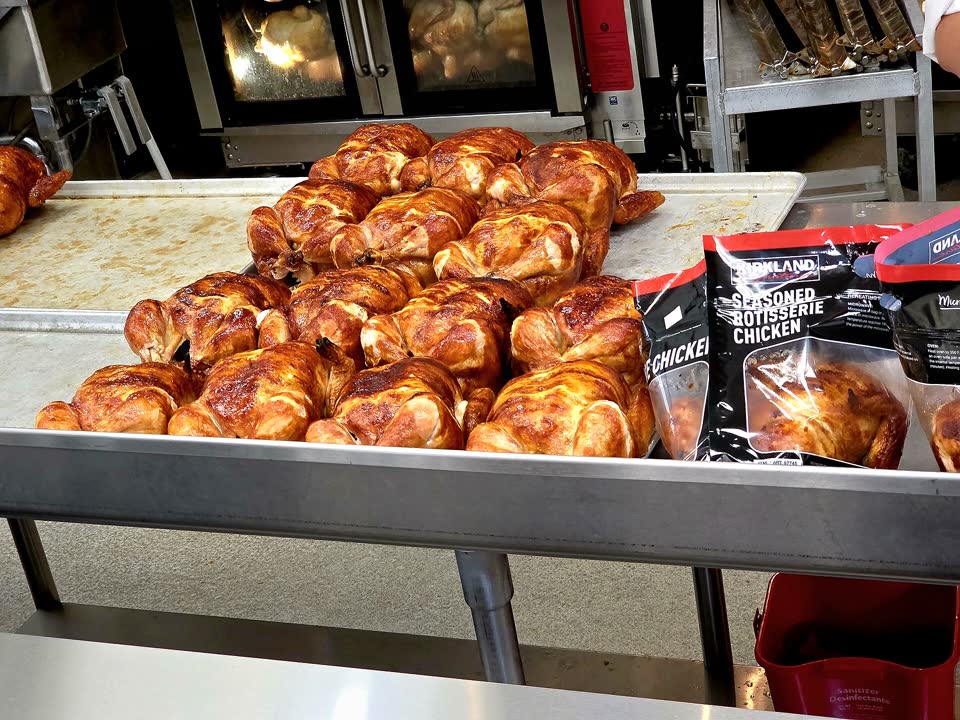

The hot dog isn’t alone. The rotisserie chicken still costs $4.99. To keep it there, Costco built its own $450 million chicken complex in Nebraska, opened in 2019.
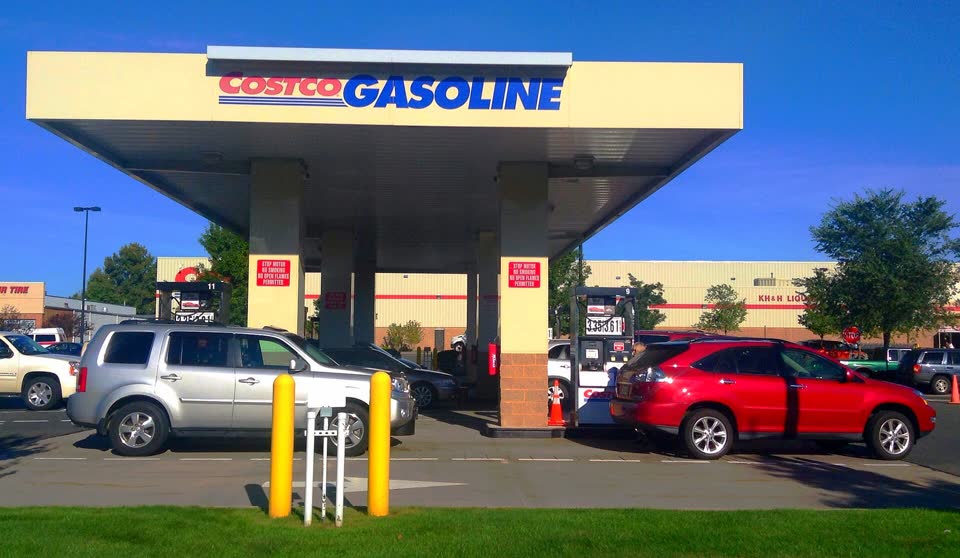

Then there’s gas: 774 stations, 11% of sales. Costco estimates it saved members more than $3.2 billion at the pump last year, about $38 per membership. One study, by Gordon Haskett on GasBuddy data, put Costco’s gas 9 cents a gallon below its five biggest local rivals. Gas buyers “visit Costco more frequently, spend more overall and renew their memberships at higher rates,” CNBC reported in July. Each of these deals exists to make the card feel worth it.
The number everyone gets wrong
Search “how Costco makes money” and you’ll read that membership fees are 64% of its profit. TheStreet wrote it in February. CNBC said “roughly two-thirds” of net income in July.
It’s misleading. Those figures divide fees, counted before tax, by net income, the profit left after tax. Compare like with like and the share drops to about 48%. Against operating income, the usual yardstick, it’s 51%. That’s the number we used in our video.
And the “Costco only makes money on cards” story misses something bigger: that share is shrinking. Fees were 72% of Costco’s operating income in 2016. They’re 51% now. Over those ten years, the profit Costco makes outside the card grew from $1 billion to $5.8 billion. More than five times as much.
The card matters less every year
Membership fees as a share of Costco’s operating income, fiscal years
See the data
| Fiscal year | Fees ÷ operating income |
|---|
Source: Costco annual reports (10-K), fiscal 2016 to 2026. Upstairs calculation: membership fees divided by reported operating income.
Get the next one on Sunday
One company or one idea, taken apart with numbers you can check. Free, once a week.
What could break it
The machine runs on one thing: people renewing. Four signs to watch.
Online sign-ups renew less. Members under 40 are now more than a quarter of the base, up almost 60% since Covid. More of them join online, some through digital promotions. These members are “generally younger” and “just renew at a lower rate,” CFO Gary Millerchip has told analysts. Worldwide renewal slipped from 90.5% in 2024 to 89.8% in 2025, and stayed there this year.
Lower-income shoppers are pulling back. Costco gained about 4.5 million shopping households over the past year, according to Numerator’s panel of 200,000 U.S. households. Most of the new ones are Gen Z or earn under $40,000 a year. And that lower-income group is already coming less often.
Walmart wants the same wallet. On October 20, Walmart launched a $120-a-year bundle of Walmart+ and Sam’s Club Plus, $10 less than Costco’s Executive card. Sam’s Club knows the model: in its last fiscal year, its membership and other income ($2.5 billion) was bigger than the entire segment’s operating profit ($2.4 billion), according to Walmart’s annual report.
AI shopping tools. For the first time, Costco’s annual report warns that AI tools could change how people shop. AI “may also present inaccurate pricing or product data, or fail to capture the full value of our membership offering.” A bot that compares prices line by line doesn’t count what the card is worth.
The stock market, for its part, is betting the card holds. In mid-October, Costco traded at about 42 times its expected earnings, against 36 for Walmart and 16 for Target. Costco’s own annual report warns that its share price reflects “high market expectations,” renewal rates included.
What you can do with it
If you shop there. The basic card pays for itself fast if Costco is much cheaper where you live. Consumer Reports found it 21% cheaper than Walmart on groceries across six U.S. metro areas in 2025: at that gap, your $65 comes back after about $300 of shopping.
Around Seattle, Checkbook found it only 9% cheaper than Walmart and 6% cheaper than WinCo. There, you need $700 to $1,100 to break even.
The $130 Executive card only beats the $65 one above this much in eligible purchases a year. Gas, tobacco and gift cards don’t count, and Costco’s terms say the reward isn’t guaranteed to cover the upgrade.
If you sell something. The same logic works at a smaller scale: charge for access, keep prices close to cost, and pick one product so cheap that people talk about it. So what’s your hot dog?
Downstairs, the noise. Upstairs, the facts.One step up on AI, business and money. Every Sunday.
One Floor Up is the free Sunday email from Upstairs: one company or one idea, taken apart with numbers you can check.
Sources and method
Figures are for Costco’s fiscal year ended August 30, 2026, unless stated. We check each figure against two sources wherever they exist, and say so when a figure rests on a single study. “Our math” means a calculation from the companies’ annual reports. Nothing here is investment advice.
Costco
- Annual report (10-K), fiscal 2026: fees, rewards, members, renewal rates, balance sheet, gas, risk factors. Earlier annual reports, fiscal 1994 to 2025: fee history, renewal rates, operating income.
- Fourth-quarter and fiscal 2026 results, September 24, 2026, and the earnings call transcript.
- Executive rewards terms.
Press and studies
- Home Textiles Today, May 2007 and WSB-TV, November 2016: the margin cap and the fee quote.
- Food Industry Association, 2025: items in an average supermarket.
- Fox Business, March 2022: the rhythm of fee raises.
- Yahoo Finance, September 2026: Executive members’ share of sales.
- ThePricer, August 2026; Supermarket News, October 2019; Fortune, May 2015; CNN, October 2019: the rotisserie chicken.
- CNBC, July 2026: gas prices (Gordon Haskett study on GasBuddy data, a single study) and the “two-thirds” figure.
- TheStreet, February 2026 and Money, October 2019: the “64%” and “essentially all” claims.
- Mental Floss, 2018, updated 2023 and TODAY, September 2020: the 2018 hot dog quote. Costco, annual meeting, January 2026, via Chowhound: 245.1 million combos in fiscal 2025.
- Numerator via Chain Store Age, September 2026: new and lower-income households (a single panel).
- CNBC, October 2026 and Walmart annual report, fiscal 2026: the bundle and Sam’s Club.
- Zacks via Yahoo Finance, October 13, 2026: forward earnings multiples.
- Consumer Reports, February 2026 and Checkbook (Seattle area, January 2026, a single study): price gaps.
Photos
- Food court, Costco Wholesale Queens, New York: Deans Charbal, Wikimedia Commons, CC BY-SA 4.0, resized.
- Rotisserie chickens: Cullen328, Wikimedia Commons, CC BY-SA 3.0, resized.
- Costco gas station: Mike Mozart, Wikimedia Commons, CC BY 2.0, resized.